
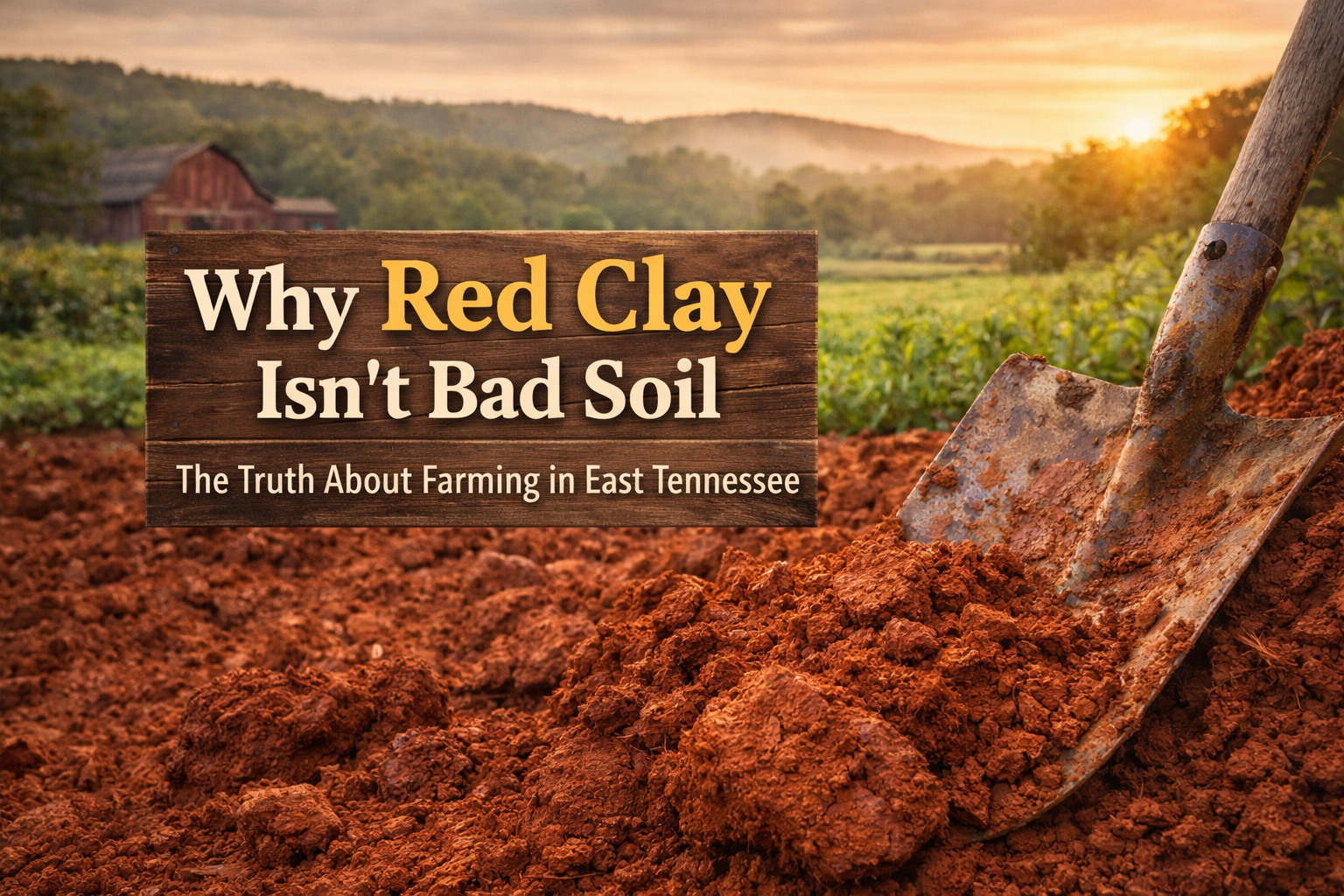
The Truth About Farming in East Tennessee
If you’ve ever dug a shovel into East Tennessee ground, you’ve probably hit red clay.
It sticks to your boots.
It bakes hard in summer.
It turns slick after a heavy rain.
And most people assume it’s terrible soil.
It’s not.
It’s misunderstood.
The Secret of Red Clay
Red clay gets its color from iron. That iron tells you something important:
This soil is mineral rich.
The challenge is not nutrients. The challenge is structure.
Clay particles are extremely small. They pack tightly together, which means:
- Water drains slowly
- Roots struggle in compacted areas
- Air circulation is limited
But when clay is managed correctly, it becomes one of the most productive soil types in the country.
The Mistake Most Farmers and Gardeners Make
They try to fight clay.
They till it.
They sand it.
They disturb it repeatedly.
Every time clay is tilled aggressively, its natural aggregates break down. When heavy Tennessee rains hit, it compacts even harder.
The result is a cycle of:
Till → Compact → Till → Compact.
The Better Way: Build Structure, Not Disturbance
Clay improves when you increase organic matter and soil biology.
Here’s what actually works in our region.
Step 1: Add Carbon
Leaves, compost, cover crops, and mulch feed microbes.
Microbes produce glomalin, a sticky protein that binds soil particles into aggregates. That creates space for air and water.
Step 2: Keep Living Roots in the Ground
Bare soil dies quickly in the Tennessee heat.
Cover crops like crimson clover or winter rye send roots deep into clay, naturally aerating it without mechanical disturbance.
Step 3: Minimize Tillage
Less disruption allows fungal networks to establish. Arbuscular mycorrhizal fungi extend root systems dramatically, helping crops access nutrients locked inside clay.
Why Clay Is Actually an Advantage
Once structured properly, clay:
- Holds moisture during summer droughts
- Retains nutrients better than sandy soils
- Produces strong root systems
In East Tennessee’s humid climate, that moisture retention becomes an asset.
What This Means for Local Farms
If you farm here long enough, you realize something:
The goal is not to change the soil into something else.
The goal is to partner with what’s already here.
Clay rewards patience.
The farms that thrive here long term focus on:
- Organic matter
- Biodiversity
- Soil cover
- Rotation
Not constant disturbance.
A Different Way to Look at It
Instead of seeing red clay as a problem, see it as potential.
It’s dense because it hasn’t been biologically activated.
Give it carbon.
Give it roots.
Give it time.
It will respond.